


The AI Advantage: Eliminating the Admissions Verification Bottleneck
AI-powered admissions verification
What happens when manual checks can’t keep pace with admissions?
Manual verification at university scale is a silent choke point that delays every offer letter, stalls every enrolment, and drowns staff in the nightmare of cross-checking multiple documents for every single applicant. Without AI-powered admissions verification, each admissions cycle becomes an uphill battle. A top American university receives thousands of applications every cycle, all requiring careful validation. Despite assigning a dedicated team of human reviewers, the sheer volume and complexity of document verification became a bottleneck, slowing the entire admissions process to a crawl.
Every cycle, thousands of applicants submitted GRE/TOEFL scores, passports, and transcripts. Staff had to manually verify every field:
- Do names match the passport?
- Do test scores match the uploaded reports?
- Does the GPA align with the transcript?
The Fallout of Manual Delays
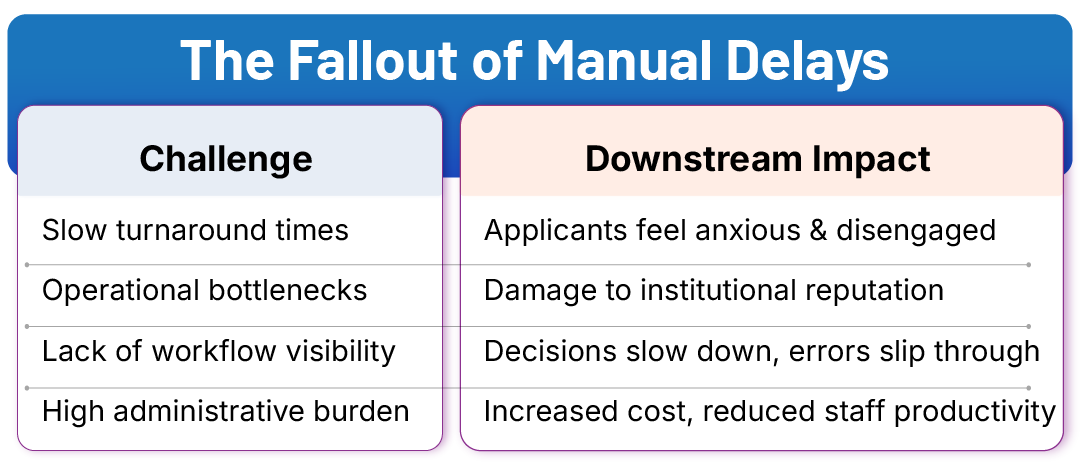
In effect, high-impact talent was tied up doing low-impact data matching.
Evoke’s AI Approach: Automated, Accurate, and Built for Scale
AI-powered admissions verification eliminates manual friction while improving accuracy at scale.
Evoke Technologies redesigned the entire verification process with an AI-driven, event‑based pipeline that fits seamlessly into the university’s existing ecosystem.
What Evoke Delivered
Zero-touch ingestion
Documents uploaded by applicants are stored in AWS S3, triggering the verification pipeline automatically.
LLM-based document understanding
A dynamic prompt-crafting engine tailors extraction logic for each document type—passports, transcripts, scorecards, etc.
Data extraction + intelligent cross-checking
The AI engine extracts names, scores, dates, institutions, and IDs, then compares them with application entries.
Human-in-the-loop accuracy
Perfect matches auto-validate; mismatches are flagged for review—ensuring reliability without manual load.
Real-time visibility
Dashboards and automated notifications keep staff informed without constant monitoring.
SOLUTION ARCHITECTURE WORKFLOW
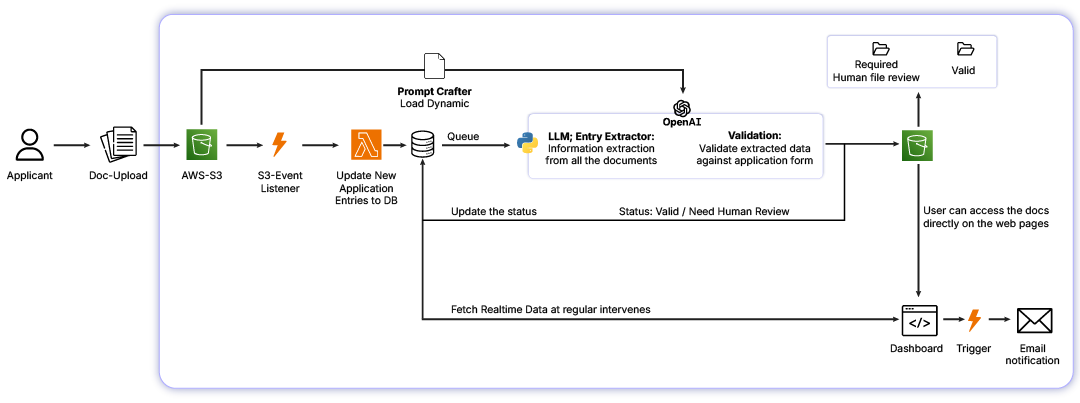
The Result: AI-driven verification didn’t just speed up a process—it fundamentally changed what the admissions team could focus on. Staff moved from chasing documents to evaluating candidates. Offer letters went out faster. Applicants experienced a smoother, more responsive process.
The technology behind AI-powered admissions verification is proven. The architecture is ready. If your admissions cycle is still running on manual verification, the question isn’t whether to automate — it’s how soon.
Talk to Evoke about deploying AI-powered admissions verification for your next admissions cycle.
Frequently Asked Questions (FAQs)
1. What is AI-powered admissions verification?
AI-powered admissions verification is an automated system that uses artificial intelligence and large language models (LLMs) to extract, validate, and cross-check applicant documents such as transcripts, passports, and test scorecards. It replaces slow manual reviews with instant, accurate, and scalable verification, helping universities process thousands of applications without bottlenecks.
2. How does AI-powered admissions verification work?
The process works in four steps: (1) applicants upload documents to a secure cloud storage like AWS S3, (2) the AI pipeline is triggered automatically, (3) LLMs extract key data such as names, scores, and institutions, and (4) the system cross-checks extracted data against application entries. Matches auto-validate, while mismatches are flagged for human review — this human-in-the-loop design ensures both speed and accuracy.
3. Is AI-powered admissions verification accurate and reliable?
Yes. Modern AI admissions verification systems use advanced LLMs combined with a human-in-the-loop model to ensure high accuracy. Perfect matches are auto-validated, and only edge cases or mismatches are escalated to human reviewers. This hybrid approach reduces human error, eliminates inconsistencies, and delivers reliability that manual processes simply cannot match at scale.
4. How much time can universities save with automated admissions verification?
Universities typically reduce document verification time by 70–90% after adopting automated admissions verification. What once took weeks of manual cross-checking can now be completed in minutes, allowing admissions staff to focus on candidate evaluation rather than data matching. Faster turnaround also improves applicant experience and boosts enrolment conversion rates.
5. Is AI-powered admissions verification secure and compliant?
Yes. Enterprise-grade AI-powered admissions verification solutions are built on secure cloud infrastructure like AWS, with encryption in transit and at rest. They comply with data protection regulations such as GDPR and FERPA, include audit trails for every verification decision, and offer role-based access control — ensuring applicant data is handled with full confidentiality and governance.
6. How quickly can a university deploy an AI verification system?
Most universities can deploy an AI document verification solution within 6–12 weeks, depending on integration complexity. Because the system is event-driven and built on existing cloud tools, it slots into current admissions workflows without disrupting operations. Evoke’s team handles integration, testing, and staff onboarding so the solution is live before the next admissions cycle begins.
7. What types of documents can AI verify in the admissions process?
An AI-driven verification system can process a wide range of admissions documents, including passports, national IDs, academic transcripts, degree certificates, GRE/GMAT/TOEFL/IELTS scorecards, recommendation letters, financial statements, and visa documents. The dynamic prompt-crafting engine adapts extraction logic for each document type, ensuring accuracy across different formats and institutions worldwide.